
Evolutionary Layers of the Human Brain
Amygdala vs. Prefrontal Cortex

“The Universe is under no obligation to make sense to you.” ― Neil deGrasse Tyson
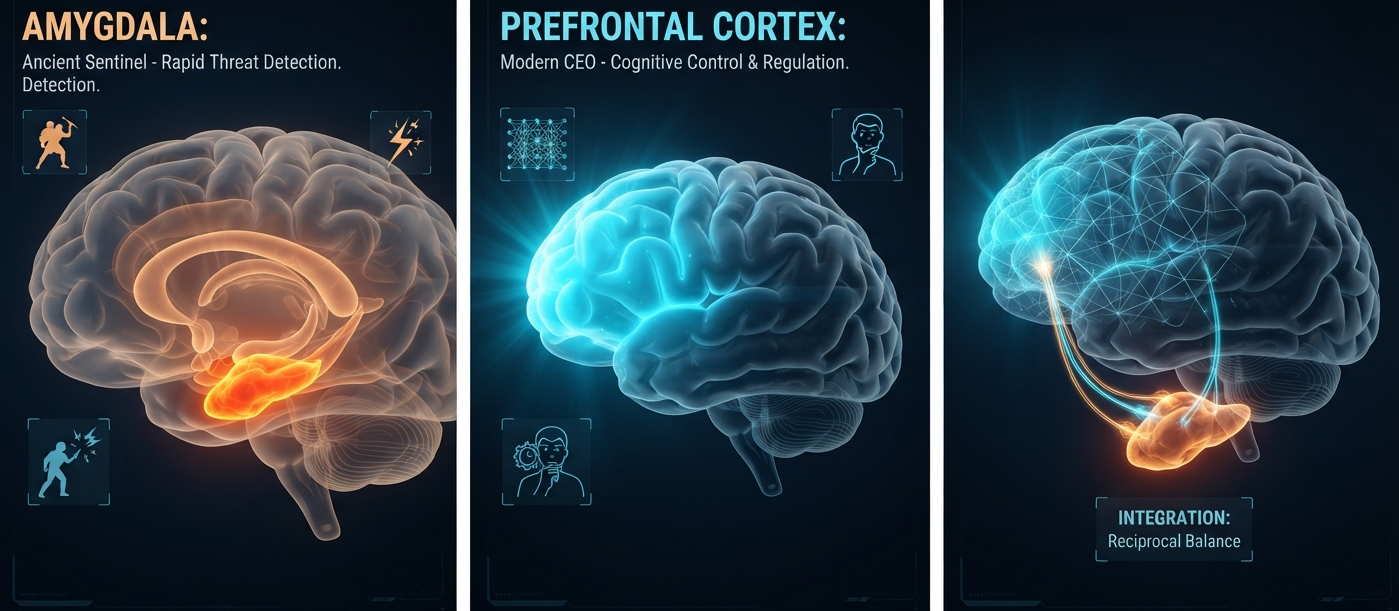
To truly understand how the human brain processes threats, decision-making, and emotional regulation, we must look at the brain through an evolutionary lens. Specifically, looking at the structural and functional dichotomy between the amygdala and the prefrontal cortex (PFC) reveals a fascinating dialogue between our ancient survival architecture and our modern cognitive machinery.
Table of Contents
The Amygdala: The Ancient Sentinel of Survival
Evolutionary Origin
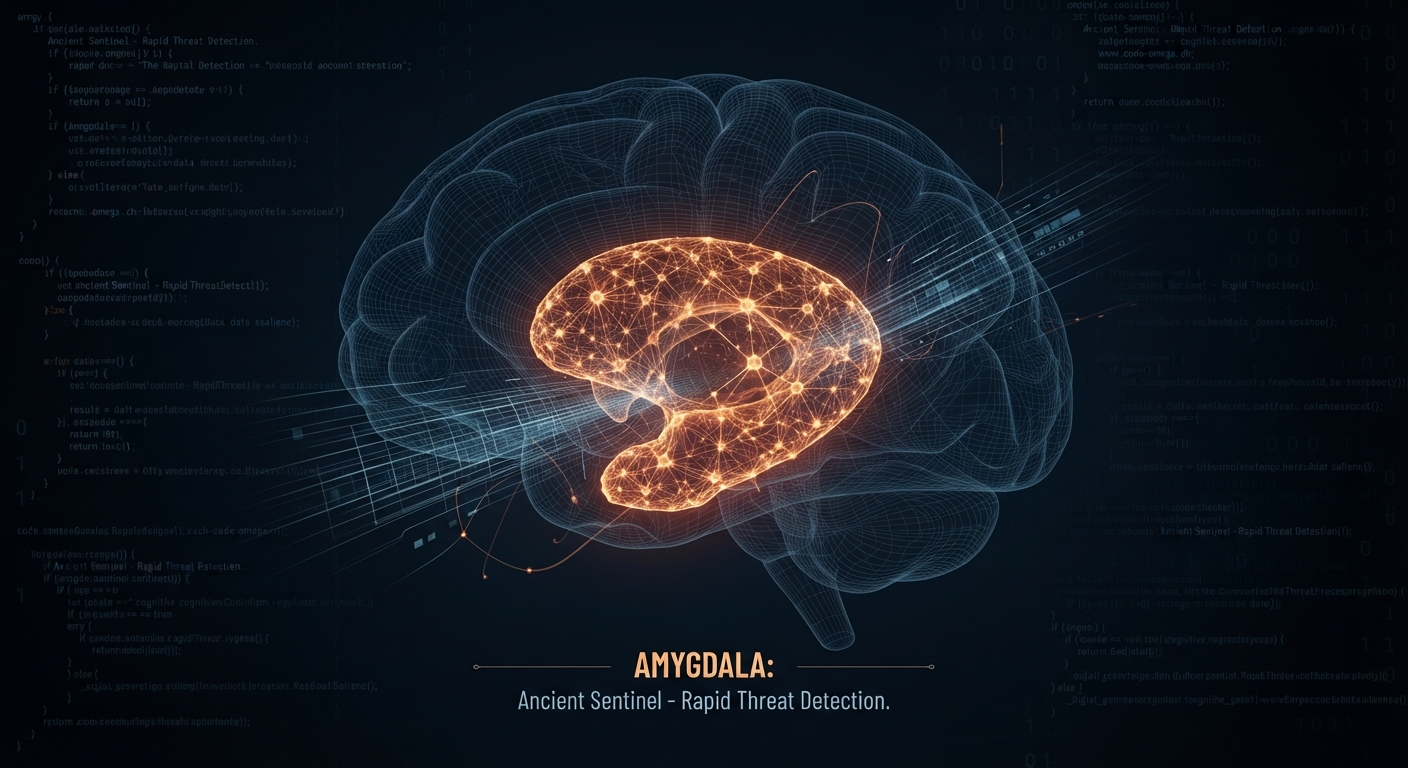
The amygdala is part of the limbic system and is deeply embedded within the temporal lobes. Evolutionarily speaking, it is ancient. Subcortical structures resembling the mammalian limbic architecture date back hundreds of millions of years, found in early vertebrates and reptiles. It represents the "repertory of survival" inherited from long before complex reasoning or abstract language existed.
Core Functions & Clinical Relevance
Rapid Threat Detection & Salience Processing: The amygdala functions primarily as an autonomic and emotional smoke detector. It processes sensory information bypassing conscious awareness via the "low road" (thalamus-to-amygdala pathway), triggering immediate physiological shifts before the cortex even registers the exact nature of the threat.
Autonomic & Endocrine Mobilization
Activation directly stimulates the hypothalamus to unleash the sympathetic nervous system and the HPA (hypothalamic-pituitary-adrenal) axis—deploying adrenaline and cortisol.
Emotional Memory Consolidation
It tags experiences with emotional valence, ensuring that life-threatening or highly rewarding scenarios are seared into memory for future avoidance or pursuit.
In non-neurological clinical settings, an overactive or chronically sensitized amygdala is frequently witnessed in individuals dealing with chronic pain, generalized anxiety, or systemic hyperarousal states. It acts without context, driven purely by pattern recognition and survival urgency.
The Prefrontal Cortex (PFC): The Evolutionary CEO
Evolutionary Origin
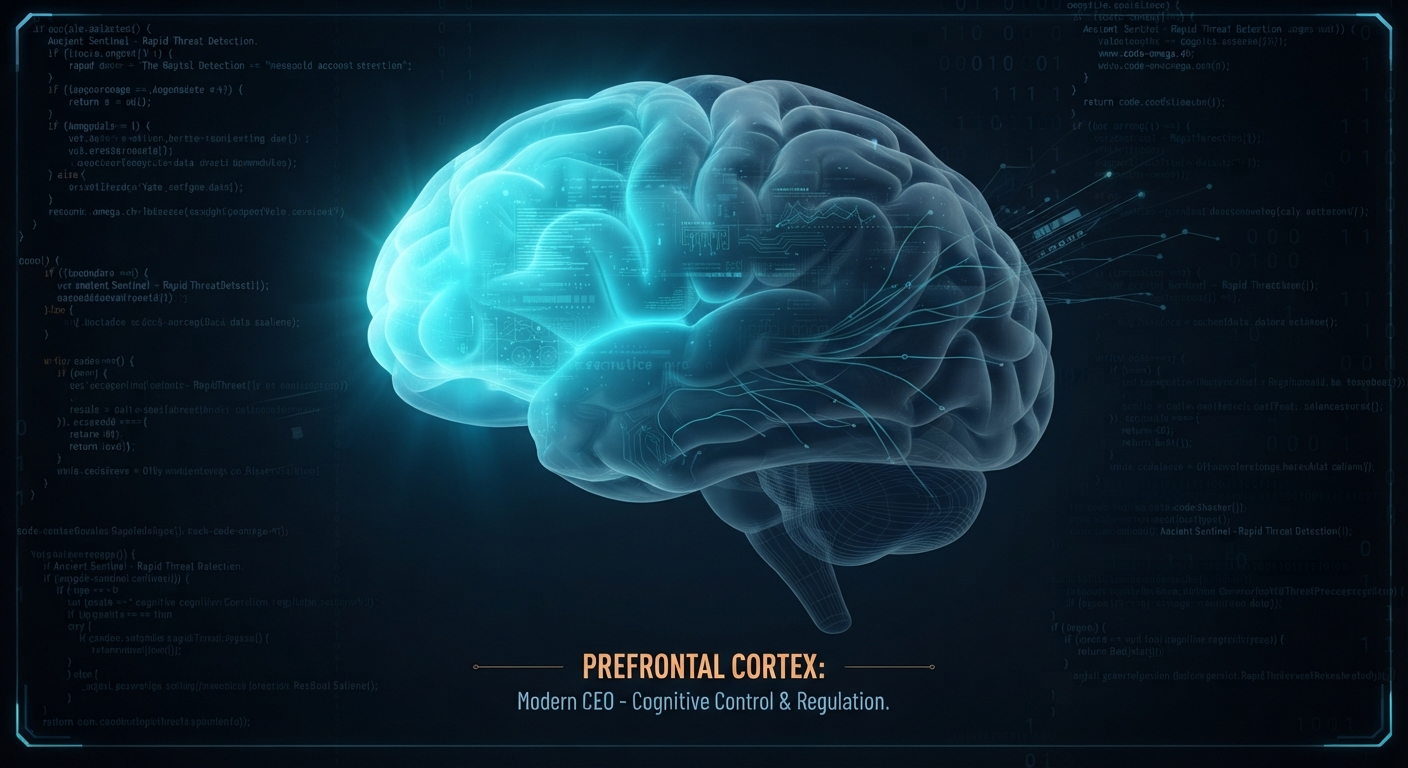
In stark contrast, the prefrontal cortex—particularly the ventromedial, dorsolateral, and frontopolar regions—is a late evolutionary newcomer. While present in rudimentary forms in other mammals, the human PFC underwent a massive, unprecedented expansion during hominid evolution, making up nearly a third of the total human cortical surface. It is the hallmark of modern Homo sapiens.
Core Functions & Clinical Relevance
Executive Functioning & Cognitive Control
The PFC is responsible for working memory, abstract reasoning, future planning, impulse control, and cognitive flexibility.
Top-Down Emotional Regulation
Through dense reciprocal inhibitory pathways down to the limbic system, the PFC evaluates context ("Is that shadow a bear, or just a coat rack?") and modulates or dampens the amygdala’s primitive alarm response.
Social Cognition and Morality
It integrates empathy, theory of mind, social norms, and long-term consequences into behavioral output.
When a patient undergoes metabolic encephalopathy, severe sleep deprivation, frontal lobe ischemia, or chronic psychological burnout, the energy-intensive PFC is often the first system to go "offline." When the PFC fails to exert top-down control, the ancient amygdala takes the steering wheel—resulting in impulsivity, poor clinical compliance, irritability, or emotional lability.
The Evolutionary Dynamic: Integration Over Opposition
For decades, medical education framed these structures in a simple dualistic battle: the "emotional, primitive" brain versus the "rational, civilized" brain.
However, modern neurobiology highlights that they are profoundly interdependent. The ancient origin of the amygdala provides the necessary drive, energy, and urgency to care about survival, while the recent origin of the prefrontal cortex provides the nuance, context, and long-term strategy.
Human behavior is the continuous negotiation between these two evolutionary layers. Understanding that acute distress responses stem from an ancient subcortical layout—which must be gently managed by a metabolically demanding, modern cortical overlay—provides a clearer, more compassionate framework for holistic understanding of ourself and others.
Visualization (simplified)
graph TD
    subgraph Subcortical["Ancient Origin"]
        A["Amygdala,
Limbic Core"] -->|"Rapid, Unfiltered Threat Detection &
Emotional Drive"| B("Autonomic & Endocrine Mobilization")
    end

    subgraph Neocortical[Recent Origin]
        C["Prefrontal Cortex - PFC"] -->|"Contextual Regulation & Inhibition"| A
    end

    B --> D["Behavioral & Clinical Output"]
    C --> D

    style A fill:#ffcc80,stroke:#d35400,stroke-width:2px,color:#000
    style C fill:#85c1e9,stroke:#2980b9,stroke-width:2px,color:#000
    style D fill:#d5f5e3,stroke:#27ae60,stroke-width:2px,color:#000
Sources
- Evolutionary development of the amygdaloid complex
- Evolution of prefrontal cortex
- Evolutionarily-conserved prefrontal-amygdalar dysfunction in early-life anxiety
This arcticle and the illustrations were created using AI tools and agents.
Comments