
AI (13)

MCP Apps

Beyond Text

How MCP Apps are Revolutionizing Agentic UIs
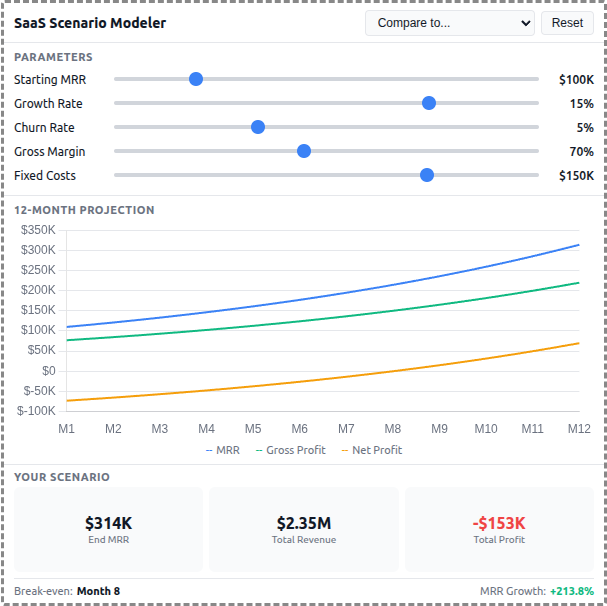
SaaS Scenario Modeler

In the rapidly evolving field of AI and LLM-powered agents, the paradigm has traditionally been text-in, text-out. Models operate by generating text—summarizing, explaining, or providing structured data. While powerful, this text-only interaction often falls short when a human user requires not just information, but an interactive experience—a dashboard to filter, a form to complete, or a rich media viewer to manipulate.

I believe the future of intelligent agents must be multimodal and highly interactive. That is why I am excited to dive into the MCP Apps (Model Context Protocol Applications) extension, a ground-breaking standard that brings rich, interactive UIs directly into the conversation thread.


The Meta-Agent

AI development is not only about maximizing generative output; it is also about maximizing reliability, controllability and costs. Frontier models have excellent reasoning abilities and a huge knowledge. They are brilliant minds which can handle most problems autonomously.

But there's a price to pay (literally in 💲), as well as privacy risks and infrastructure dependency.

The S.H.O.D.A.N. project is for my personal education - but also to mitigate those risks without loosing quality. Mainly driven by my personal token consumption - which is way higher than I'm willing to pay for 😉.

The mythical man

Ariane flight V88 [ESA]

In conjunction with the adoption of generative AI and AI assisted development I had a very interesting discussion with a co-worker in my company. He is specialized to analyze bussines processes and to do management coaching. We discussed the role of AI in our SDLC, and what could/should be improve that is known in theory since quite a while.


He pointed me to a book written by Frederick P. Brooks: The mythical man-month

Sandbox #2 (cont.)

I could ask my local LLM to write a script, troubleshoot a Docker container, or explain how to organize a folder full of files, and it would usually give me a sensible answer. That answer was also where its job ended. My local LLM could not handle an entire task on its own.

[Anurag Singh]

Focus

There is a strong focus on technology at the moment. Which model performs better, how to manage knowledge - vector stores vs. markdown ... But considering the vast and fast changes in the last months technology will be outdated sooner rather than later.

But there are things more resilient to time. For example how to approach and solve a problem.

Process
  flowchart LR
      Start(["⚡ Problem"])
      Stop([🛑 Stop])
      Delegate["📥 Delegate 😋"]
      Solve["🛠️ Solve ⚙️"]
      Solved(["✅ Solved"])

      RealProblem{Real?}
      MyProblem{Mine?}

      Start([Problem]) --> RealProblem
      RealProblem      --> Stop
      RealProblem      -->|Yes| MyProblem
      MyProblem        --> Delegate --> Stop
      MyProblem        -->|Yes| Solve --> Solved
    
      classDef A fill:#e6f7ff,stroke:#0099cc,stroke-width:2px;
      classDef B  fill:#f1f8e9,stroke:#5cb85c,stroke-width:2px;
      class Solve,Delegate A;
      class RealProblem,MyProblem B;  
  

Yes - processes evolve and AI could be a pivoting point here as well. But in the end - I do not even think the process needs to change much; rather the focus of the human role ....

Sandbox

Sandbox

Actually - I did not even like them as a child; prefered to create some of my first programs on my C16. But at the moment they are a big source of frustration. I was used to use AI in Visual Studio Code - and it was a well integrated environment/experience. It is possible to use it with BYOK to connect it to your local AI ...