
The Meta-Agent
Dynamic Promts and Context Injection ...
“The Universe is under no obligation to make sense to you.” ― Neil deGrasse Tyson
AI development is not only about maximizing generative output; it is also about maximizing reliability, controllability and costs. Frontier models have excellent reasoning abilities and a huge knowledge. They are brilliant minds which can handle most problems autonomously.
But there's a price to pay (literally in 💲), as well as privacy risks and infrastructure dependency.
The S.H.O.D.A.N. project is for my personal education - but also to mitigate those risks without loosing quality. Mainly driven by my personal token consumption - which is way higher than I'm willing to pay for 😉.
Exploration during Phase 0 prooved the raw power can be substitudet to a degree by a smart workflow and resource management — which dynamically adapts to the problem, also during execution.
⚙️ The Shift ...
... from static Tools & Pools to a reactive Pipeline
The power of the Orchestrator is its ability to manage the meta-process. It is not just executing tasks; it is managing the constraints of those tasks.
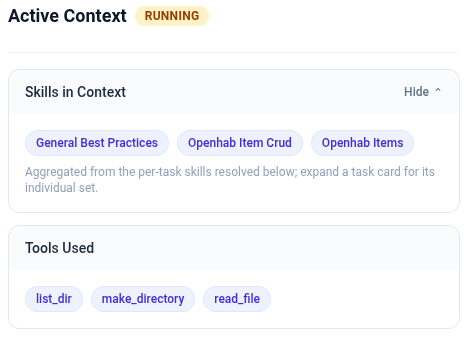
By decomposing the work, an execution plan is created, as well as specialized agents.
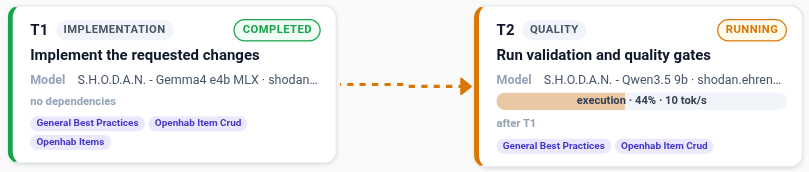
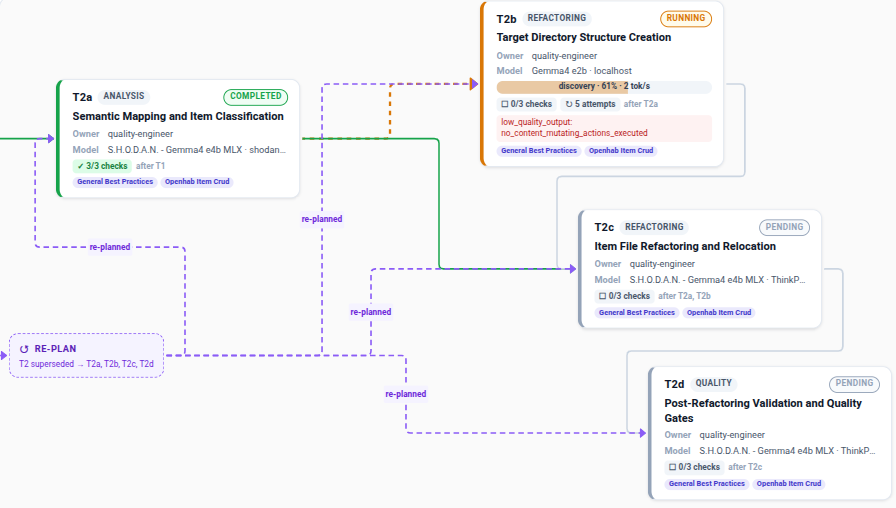
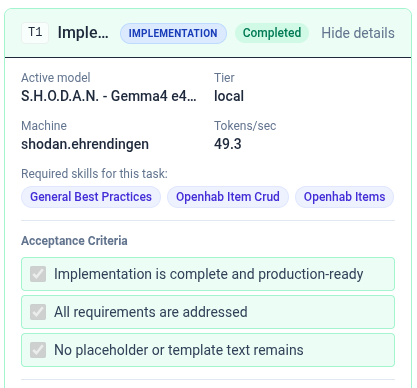
The agents LLM, system prompt and context is tailored to the task it will have to handle. Small, iterative feedback loops provide the information to dynamically adjust every element of the system if necessary.

The architecture rests on three pilars:
- Categorisation, Planning and Risk Management
- Execution, Validation & QA
- Self-Correction & Feedback
S.H.O.D.A.N.
Phase 0
Concept (simplified)
graph TD
  A["IDE"]
  A <-->|"MCP"| B

  subgraph SHODAN["S.H.O.D.A.N."]
    B["Orchestrator"]
    Skills["📚 Skills"]

    B <--> Layers
    Layers -.-> T
    Skills -.-> Layers

    subgraph T["Plan"]
      T1["📄 Task"]
      T2["📄 Task"]
      T3["📄 Task"]

      T1-->T2-->T3
    end

    subgraph Agents["Agents"]
      P1["⚙️ A1"]
      P2["⚙️ A2"]
      P3["⚙️ A3"]
    end

    Layers -.-> Agents

    subgraph Layers["Layers"]
      L1["Planning"]
      L2["Execution"]
      L3["Review"]
    end

    L1 --> L2 --> L3 --> L1
  end


classDef agent fill:#e6f7ff,stroke:#0099cc,stroke-width:2px;
class P1,P2,P3,P4 agent;

classDef step fill:#f1f8e9,stroke:#5cb85c,stroke-width:2px;
class L1,L2,L3 step;

classDef task fill:#f1f1f1,stroke:#2b6c4f,color:000000,stroke-width:2px;
class T1,T2,T3,T4,T5 task;
Comments