
Projects (7)

Chromecast with Waydroid

There are many sophisticated Media Players for Linux with Jellyfin Server support. But some of them lack Chromecast and/or DLNA support - and if you are working from home with a coorperate device a native application is not an option. Therefore I'll try to integrate support to the docker version of Feishin ... 

[Feature]: Add DLNA renderer discovery ...

But as an interim solution I'll use another approach on my development Laptop to improve my networking and container skills a bit ...

Speculative Decoding

In the rapidly evolving landscape of locally hosted Large Language Models (LLMs), performance often remains the primary bottleneck. While quantization and efficient kernel implementations have made running powerful models on consumer hardware a reality, a significant efficiency gap remains. This gap is bridged by speculative decoding, an advanced inference technique that allows local LLMs to operate with significantly greater throughput.

This post provides a technical summary of how speculative decoding works, the core mechanism, best practices for choosing a draft model, and the setup required for various tooling environments.

Deterministic Decision Models

The Foundational Instability of Soft AI Outputs

The prevailing paradigm in LLM application development—relying on models to output descriptive text — is, from a systems engineering perspective, inherently unstable. When an LLM outputs a string — e.g., "billing" — this is not a guarantee; it is a hypothesis. Downstream systems must spend cycles to stabilize the output (regex parsing, string comparison, etc.). This uncertainty exposes the pipeline to linguistic variations.

A dynamic system using models from multiple vendors with different capabilities is vulnerable to such effects.

The Decision Model paradigm, formalized by typesafe.ai, addresses this constraint directly. These models do not generate text for aesthetic consumption; they are specialized, fast systems designed to eliminate ambiguity by returning deterministic, quantifiable outcomes: a choice, a confidence score, and a probability distribution.

Ollama Blog

System One Models in Practice

The Experiment Evolves

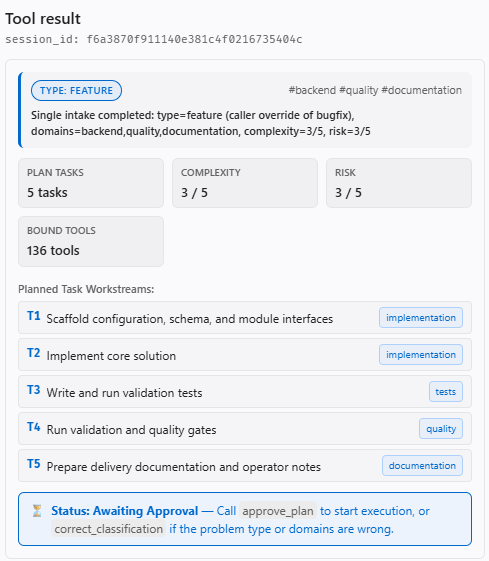
The project evolves from an MCP-centred experiment into a persistent, observable, and explicitly supervised runtime for multi-step software-engineering work.

Agent Orchestrator

Interaction using MCP App

The most important change in the project is not the addition of another model, tool, or user interface. It is a change in architectural responsibility.
What began as an exploration of how agents and Model Context Protocol tools can cooperate evolves towards a supervised orchestration runtime. The current system no longer treats a model response as the workflow. Instead, it treats model calls as one part of a durable process that has an identity, an explicit plan, dependency-aware tasks, policy-controlled actions, recovery stages, operator handoffs, and observable results.

The Meta-Agent

AI development is not only about maximizing generative output; it is also about maximizing reliability, controllability and costs. Frontier models have excellent reasoning abilities and a huge knowledge. They are brilliant minds which can handle most problems autonomously.

But there's a price to pay (literally in 💲), as well as privacy risks and infrastructure dependency.

The S.H.O.D.A.N. project is for my personal education - but also to mitigate those risks without loosing quality. Mainly driven by my personal token consumption - which is way higher than I'm willing to pay for 😉.

Sandbox #2 (cont.)

I could ask my local LLM to write a script, troubleshoot a Docker container, or explain how to organize a folder full of files, and it would usually give me a sensible answer. That answer was also where its job ended. My local LLM could not handle an entire task on its own.

[Anurag Singh]

Another POC ...

Here is some additional motivation for you:

"Today's your chance to crush it, but let's be real, you'll probably just end up procrastinating and eating Cheetos on the couch at 3 PM."