“The Universe is under no obligation to make sense to you.” ― Neil deGrasse Tyson
I could ask my local LLM to write a script, troubleshoot a Docker container, or explain how to organize a folder full of files, and it would usually give me a sensible answer. That answer was also where its job ended. My local LLM could not handle an entire task on its own.
The LLM is the Brain, but it can only give instructions - it can not act. An agent communicates directly with an LLM to execute those instructions and to report the result. The communication relies on Structured Outputs / Function Calling APIs.
JSON schema representations of functions (tools) passed alongside the prompt messages. The agent sends the full conversation history and tool definitions. The LLM responds with a structured payload (e.g., tool_calls containing the function name and arguments) instructing the agent framework on what action to execute next.
How additional context (files,images, audio) is handled depends on the provide and/or model.
As in real life - it is a commuication problem - so let's see what we have available and what is best suited for this problem:
Protocol
Use-Case(s)
Maturity
Model Context Protocol (MCP)
Share model metadata between agents and LLM back-ends; enables "model-aware" coordination.
8/10
Agent Communication Protocol (ACP)
General inter-agent request/response pattern for coordination among specialized agents.
6/10
AnonP2P (ANP)
Secure, decentralized communication for autonomous agents; supports identity verification and trust management.
7/10
Agent-to-Agent Protocol (A2A)
Low-level request/response pattern for coordination between specialized agents.
5/10
Tool Use & Payments Protocol (TUP)
Integrates external services, payment mechanisms, and state persistence.
4/10
Universal Agent API (UAA)
Provides a thin "plug-and-play" interface for UI frameworks to talk to any agent regardless of underlying protocol stack.
3/10
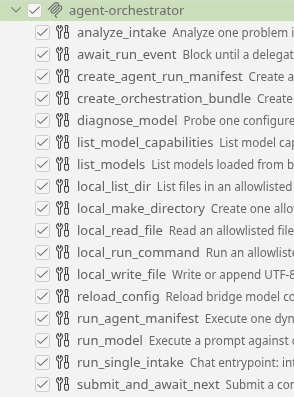
MCP seems to be the logical choice for a POC ...
Model Context Protocol (MCP)
The Model Context Protocol (MCP) is a protocol used to share model metadata between agents and LLM back-ends. It enables "model-aware" coordination, allowing models to be more intelligent and adaptable in their decision-making processes.
MCP is an essential protocol for any AI system that relies on machine learning models. By sharing model metadata, agents can gain a deeper understanding of the models' strengths and weaknesses, enabling them to make more informed decisions.
The MCP protocol provides a standardized way for agents to communicate with LLM back-ends, ensuring that models are properly initialized and configured. It also allows agents to update their knowledge of the models in real-time, ensuring that they remain accurate and effective.
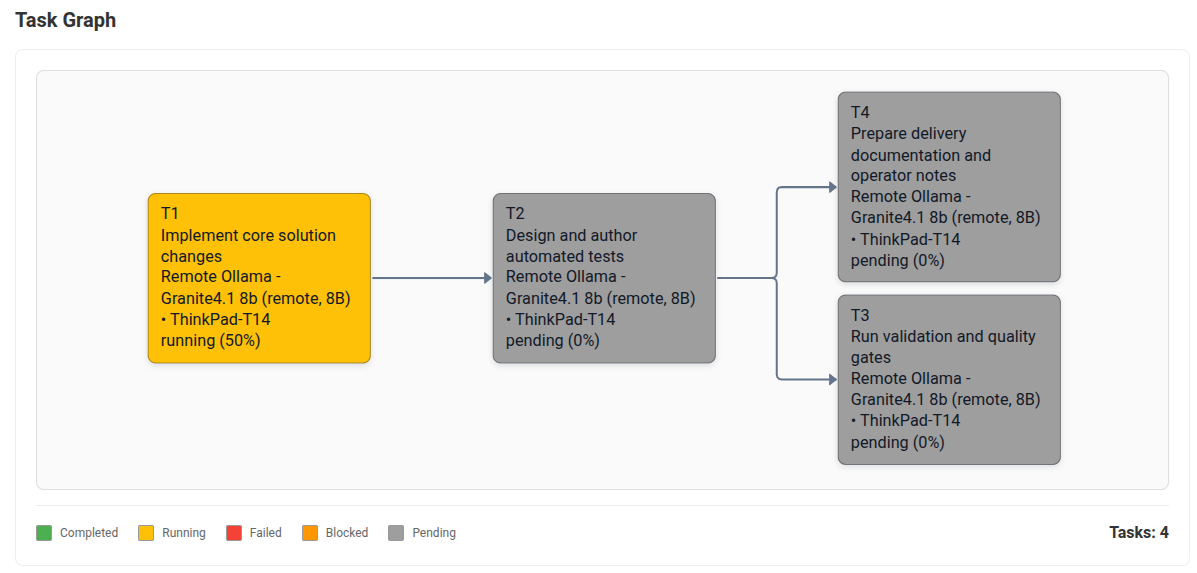
This approach also enables us to dynamically create agents and workflows that are tailored to the problem at hand; including the possibility to reject the tasks as too complex for local inference.
graph TD;
    VSCode([Visual Studio Code])
    VSCode<-->MCP

    subgraph MCP["Orchestrator (MCP)"]
      S1["🛠️ Analysis"]
      S2["🛠️ Planning"]
      S3["🛠️ Create Agent(s)"]

      S1-->S2-->S3
      S2-.->|"Creates"|Tasks
      S3-.->Pool

      subgraph Pool["Agents"]
        P1["⚙️ Specialist"]
        P2["⚙️ Specialist"]
        P3["⚙️ Specialist"]
      end

      Pool-->Tasks

      subgraph Tasks["Tasks"]
        T1["📄 Task"]
        T2["📄 Task"]
        T3["📄 Task"]
        T4["📄 Task"]
        T5["📄 Task"]

        T1-->T2
        T1-->T3
        T1-->T4
        T3-->T5
        T2-->T5
      end
    end

    classDef agent fill:#e6f7ff,stroke:#0099cc,stroke-width:2px;
    class P1,P2,P3,P4 agent;

    classDef step fill:#f1f8e9,stroke:#5cb85c,stroke-width:2px;
    class S1,S2,S3 step;

    classDef task fill:#f1f1f1,stroke:#2b6c4f,color:000000,stroke-width:2px;
    class T1,T2,T3,T4,T5 task;
The Agent Communication Protocol (ACP) is a general inter-agent request/response pattern for coordination among specialized agents. It provides a standardized way for agents to communicate with each other, enabling them to work together seamlessly.
ACP is an essential protocol for any AI system that relies on multiple agents working together. By providing a standardized way for agents to communicate, ACP enables them to share information and coordinate their actions more effectively.
The ACP protocol supports a wide range of communication patterns, including request/response, publish/subscribe, and others. It also provides features such as message routing, queuing, and reliability, ensuring that messages are delivered correctly and efficiently.
AnonP2P (ANP)
AnonP2P (Anonymized Peer-to-Peer) is a secure, decentralized communication protocol for autonomous agents. It supports identity verification and trust management, ensuring that agents can communicate securely and reliably.
ANP is an essential protocol for any AI system that relies on multiple autonomous agents working together. By providing a secure and reliable way for agents to communicate, ANP enables them to share information and coordinate their actions more effectively.
The ANP protocol provides features such as end-to-end encryption, secure key exchange, and digital signatures, ensuring that agent communication is protected from eavesdropping and tampering.
Agent-to-Agent Protocol (A2A)
The Agent-to-Agent Protocol (A2A) is a low-level request/response pattern for coordination between specialized agents. It provides a standardized way for agents to communicate with each other, enabling them to share information and coordinate their actions more effectively.
A2A is an essential protocol for any AI system that relies on multiple agents working together. By providing a standardized way for agents to communicate, A2A enables them to work together seamlessly.
The A2A protocol supports a wide range of communication patterns, including request/response, publish/subscribe, and others. It also provides features such as message routing, queuing, and reliability, ensuring that messages are delivered correctly and efficiently.
Tool Use & Payments Protocol (TUP)
The Tool Use & Payments Protocol (TUP) is an integration protocol for external services, payment mechanisms, and state persistence. It provides a standardized way for agents to interact with external tools and services.
TUP is an essential protocol for any AI system that relies on external tools and services. By providing a standardized way for agents to communicate with external tools, TUP enables them to share information and coordinate their actions more effectively.
The TUP protocol supports features such as authentication, authorization, and payment processing, ensuring that agent communication is secure and reliable.
Universal Agent API (UAA)
The Universal Agent API (UAA) is a thin "plug-and-play" interface for UI frameworks to talk to any agent regardless of the underlying protocol stack. It provides a standardized way for agents to interact with user interfaces.
UAA is an essential protocol for any AI system that relies on multiple agents working together. By providing a standardized way for agents to communicate with user interfaces, UAA enables them to share information and coordinate their actions more effectively.
The UAA protocol supports features such as message routing, queuing, and reliability, ensuring that agent communication is delivered correctly and efficiently.
Actually - I did not even like them as a child; prefered to create some of my first programs on my C16. But at the moment they are a big source of frustration. I was used to use AI in Visual Studio Code - and it was a well integrated environment/experience. It is possible to use it with BYOK to connect it to your local AI ...



Comments